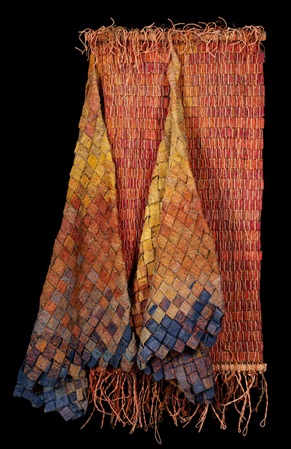
This fall, the Pulitzer Arts Foundation presents Olga de Amaral: Weaving the Infinite, the most wide-ranging investigation to date into the art of Colombian fiber artist Olga de Amaral (b. 1932). Co-organized by the Pulitzer and Cooper Hewitt, Smithsonian Design Museum, the exhibition is the first in-depth exploration of how Amaral’s practice transcended boundaries between art, craft, and design.
The exhibition illustrates Amaral’s evolution from conventional loom weaving to innovative off-loom experimentation. At the Pulitzer 86 works of art—including monumental fiber works, furnishings and clothing from Amaral’s commercial design studio, Telas Amaral, and textiles and ceramics from her personal collection—offer new insight into the relationship between her fiber art, design work, and lifelong engagement with global textile traditions.
“Amaral’s work has only recently begun to receive the broad critical recognition it deserves, and comprehensive scholarship on the full breadth of her career remains limited. This exhibition is an opportunity to help change that,” says Cara Starke, Executive Director of the Pulitzer. “At the Pulitzer, one of our core commitments is to advance art historical scholarship by addressing important gaps, especially when it comes to artists who are pivotal figures of our time. We are thrilled to partner with Cooper Hewitt, an institution whose focus on design makes it uniquely positioned to illuminate the significance of Amaral’s contributions.”
This exhibition follows Amaral’s continual experimentation with material, scale, and technique over the course of 65 years, from early textiles she produced while studying at Cranbrook Academy of Art to her large-scale fiber works created over subsequent decades.
Of particular focus is the artist’s engagement with architecture, beginning with her Muros tejidos (Woven Walls) series from the 1970s. Drawing on her early training in architectural drafting, Amaral evolved her work from flat weavings made using traditional techniques into complex constructions that respond to space, light, and the surrounding built environment. By incorporating structural materials such as heavy wool and horsehair and assembling woven elements off of the loom, she expanded both the scale and dimensionality of her work, allowing viewers to experience it from multiple perspectives. The exhibition also features two panels of Amaral’s most ambitious work, El gran muro (The Great Wall), 1976. This monumental, 16-panel fiber artwork was commissioned by architects John Portman & Associates for the atrium of the Peachtree Plaza Hotel in Atlanta.
“In organizing Weaving the Infinite, we’ve aimed to present the artworks and objects in a way that reflects how Amaral moves fluidly between artistic spheres, always sustaining a practice in which design and fine art inform one another,” says Stephanie Weissberg, Senior Curator, Pulitzer Arts Foundation, and co-curator of the exhibition.
Amaral’s design work and functional textiles are prominently featured in the exhibition, with a particular focus on Telas Amaral, the studio she co-founded with her husband, Jim Amaral, in 1957. On view are an area rug and an array of samples of thick carpets in leather, horsehair, wool and cotton, as well as upholstery woven from natural fibers, synthetic threads, and metallic materials. A woman’s dress suit in Telas Amaral cloth and a richly colored tunic inspired by the garments of Colombia’s Indigenous Wayuu people represent the studio’s fashion output.
By pairing these materials with Amaral’s fiber art, the exhibition demonstrates the connection between these two bodies of work previously considered separate. “Telas Amaral became an important site of experimentation where Olga refined her process, introducing the use of modular, repeatable units as a way to generate seemingly endless formal possibilities,” notes Weissberg.
Weaving the Infinite also places Amaral’s work in dialogue with handcrafted textiles, ceramics, and baskets she collected throughout her life, highlighting the techniques and forms that informed her artistic practice. Although a lifelong student of weaving, Amaral also pushed beyond its conventions, devising innovative techniques that broadened her creative freedom. Works from the 1970s onwards reveal her increasingly experimental approach, incorporating materials like acrylic paint, gold leaf, Japanese paper, and gesso to explore color, luminosity, and form. In doing so, Amaral has blurred the boundaries between painting, drawing, sculpture, and textile, redefining the possibilities of fiber art.
Olga de Amaral: Weaving the Infinite is co-organized by the Pulitzer Arts Foundation and Cooper Hewitt, Smithsonian Design Museum. The exhibition will be on view at the Pulitzer from September 10, 2026 through January 31, 2027, before traveling to Cooper Hewitt, where it will be presented from April 2 through October 11, 2027. It is co-curated by Stephanie Weissberg, Senior Curator, Pulitzer Arts Foundation, and Christina L. De León, Associate Curator of Latino Design at Cooper Hewitt, with support from Molly Moog, Curatorial Associate at the Pulitzer Arts Foundation, and Sophia Gebara, Curatorial Assistant of Latino Design at Cooper Hewitt.
The Artist
Olga de Amaral, née Olga Ceballos Vélez, was born in Bogotá, Colombia (b. June 14, 1932), where she continues to live. She studied architectural drafting at the Colegio Mayor de Cundinamarca in Bogotá and textiles at Cranbrook Academy of Art, Michigan, in 1954. By the 1960s she was teaching at the Haystack Mountain School of Crafts in Maine and was included in a group exhibition at MoMA, New York, entitled Wall Hangings, before staging a solo show, Woven Walls, at New York’s Museum of Arts and Design in 1970. Her work was featured in several editions of the Lausanne International Tapestry Biennial beginning in 1967. After living in Barcelona and Paris in the early 1970s she returned to Colombia, receiving her first major survey show at the city’s Museo de Arte Moderno in 1972 and representing her country at the Venice Biennale in 1986. Her work is held in many major museum collections worldwide, including the Art Institute of Chicago, Chicago, IL; Blanton Museum of Art, Austin, TX; Cleveland Museum of Art, Cleveland, OH; Cranbrook Art Museum, Detroit, MI; de Young Museum, San Francisco, CA; Metropolitan Museum of Art, New York, NY; Museum of Arts and Design, New York, NY; Museum of Fine Arts, Houston, TX; Museum of Modern Art, New York, NY; Musée d’Art Moderne de la Ville de Paris, Paris, France; Museo Nacional, Bogotá, Colombia; American Craft Museum, New York, NY; The National Museum of Modern Art, Kyoto, Japan; Rhode Island School of Design, Providence, RI; San Antonio Museum of Art, San Antonio, TX; Toledo Museum of Art, Toledo, OH; and Tate Collection, London, UK.
Publication
The exhibition will be accompanied by a fully-illustrated catalogue available in spring 2027, published by Princeton University Press, in which curators Stephanie Weissberg and Christina De Léon offer an overview of the artist’s career. A contribution by decorative arts and design historian Antonio Sánchez links Amaral’s work to Colombian sociopolitical and cultural histories. Conservator Emilia Cortes discusses the artist’s personal collection, shedding light on her deep engagement with global and local craft and textile traditions, while conservator Kira Eng-Wilmot unravels Amaral’s innovative techniques through a series of new technical analyses.
About the Pulitzer Arts Foundation
Located in the Grand Center Arts District, the Pulitzer Arts Foundation is dedicated to bringing world-class art and exhibitions to the St. Louis region. Exhibitions include both contemporary and historical art and are complemented by a wide range of free public programs, including music, literary arts, dance, and cultural discussions. Open and free to all, the Pulitzer is a cultural and civic asset to the St. Louis community and a popular destination for visitors from around the world. Since its founding, the Pulitzer has played a pivotal role in the resurgence of the Grand Center Arts District. The museum is open Thursday through Sunday, 10am–5pm, with evening hours until 8pm on Friday. For more information, visit pulitzerarts.org.
About Cooper Hewitt, Smithsonian Design Museum
Cooper Hewitt is America’s design museum. Inclusive, innovative and experimental, the museum’s dynamic exhibitions, education programs, master’s program, publications and online resources inspire, educate and empower people through design. An integral part of the Smithsonian Institution—the world’s largest museum, education and research complex—Cooper Hewitt is located on New York City’s Museum Mile in the landmarked Carnegie Mansion. Steward of one of the world’s most diverse and comprehensive design collections—over 215,000 objects that range from an ancient Egyptian faience cup dating to about 1100 BC to contemporary 3D-printed objects and digital code—Cooper Hewitt welcomes everyone to discover the importance of design and its power to change the world.
For more information, visit cooperhewitt.org